Turning Vision into Action for Washington’s Students
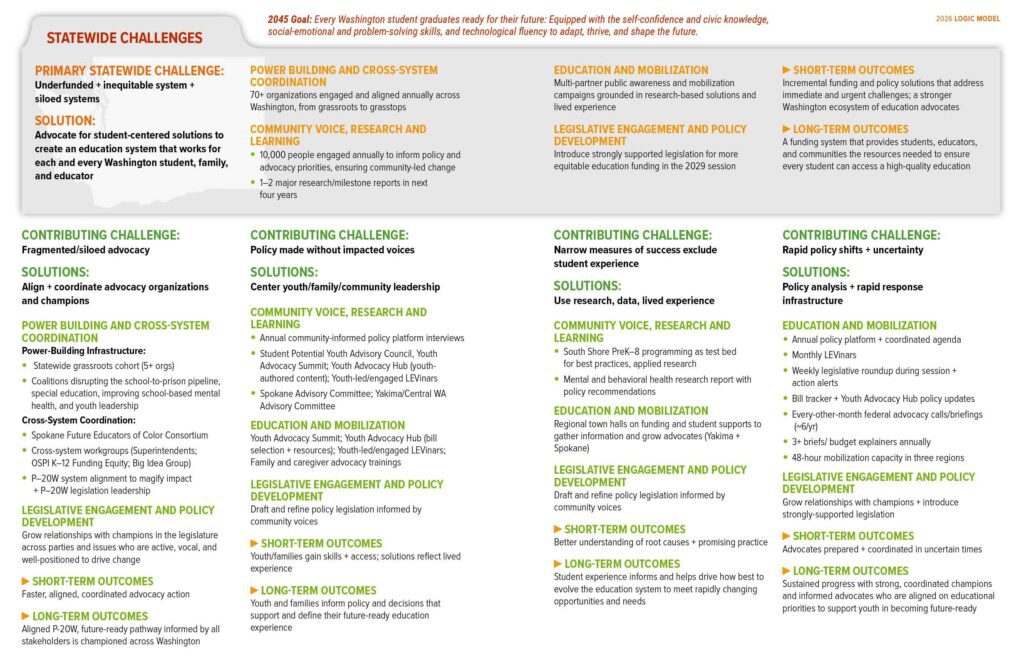
Our logic model shows how we move from strategy to effective, measurable change.
 On a typical school day, a student in Washington is navigating more than just their classes.
They might be managing anxiety without consistent access to mental health support, like the more than six in ten Washington 10th graders who report feeling anxious or nervous. They might be navigating their school year in a non-home language, like the 160,000 Washington students who are multilingual learners, or, like the 170,000 students with disabilities, trying to make their way through a system that wasn’t designed for them. They might be trying to stay engaged while moving between systems that don’t always connect, resulting in just 77% of youth from low-income households graduating on time, and only 31% of all Washington high school graduates attaining a post-secondary credential by age 26.
They might also have ideas about what would make school more relevant and about how to make the system easier and more effective, but they don’t always have a clear way to be heard.
This logic model is about connecting our collective work so that we are coordinated and aligned across Washington – from students to decision-makers – to drive positive change across our public education system.
What This Is
The League of Education Voters Foundation’s logic model is a roadmap for how our work drives systems change across Washington’s education landscape.
It translates our 2026–2030 strategic plan into a practical framework — connecting what we do every day to near-term outcomes and long-term impact for students, families, and communities.
Why This Matters Now
Washington’s education system is at a critical moment.
- Systems remain fragmented across early learning, K–12, and higher education
- Mental health needs continue to grow, while access to consistent support remains uneven
- Policy solutions too often fail to reflect the lived experiences of students and families
This logic model responds to these challenges with a shared, coordinated path forward. It clarifies how change happens, aligns efforts across the field, and strengthens our collective ability to drive results.
This work is anchored in our 2045 Goal: Every Washington student graduates ready for their future: Equipped with the self-confidence and civic knowledge, social-emotional and problem-solving skills, and technological fluency to adapt, thrive, and shape the future.
How to Use This
This logic model is a shared tool for understanding, aligning, and improving how we create change together.
- For community members, youth, and families: See how your experiences, voices, and advocacy provide the foundation for systems change — and how community leadership drives progress toward more equitable outcomes.
- For partners and advocates: View this as an invitation to collaborate as we work together to create a shared roadmap — aligning efforts, building a common vision for how change happens, and coordinating strategies across the education continuum.
- For funders and supporters: See how investments connect to specific activities, outcomes, and long-term impact — and how progress can be tracked over time.
- For policy and decision-makers: Understand how coordinated advocacy, research, and community leadership can identify and develop solutions that lead to measurable improvements in outcomes and more positive student experiences.
Our Approach
- Systems-focused: Advancing alignment across early learning, K–12, and higher education to dismantle silos and create cohesive systems that support every student’s success.
- Community-driven: Centering youth, families, and those most impacted
- Action-oriented: Linking advocacy, research, and engagement directly to outcomes
- Coordinated: Building alignment across partners to increase collective impact
Explore the Model
What This Looks Like for Students
For a student navigating their school day, this work shows up in tangible ways.
It looks like having access to mental health support when they need it. It looks like learning experiences that connect to real-world skills and future opportunities. It looks like systems that are easier to navigate, regardless of the language they speak at home. And it looks like being able to share their perspective — and see it reflected in decisions that affect their education.
Most importantly, it looks like systems that are designed with students, not just for them.
Read our 2026-2030 strategic plan
Love what we do? Support our work
Want to find out the latest in education news in Washington? Subscribe to our newsletter
Want to learn more about League of Education Voters? Find out here