By Jacob Vela, League of Education Voters Chief Policy Officer
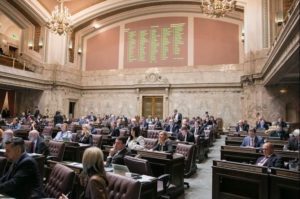 The Washington state House and Senate have released their 2026 supplemental budget proposals. The 2026 supplemental budget makes adjustments to the 2025-27 biennial budget and impacts funding for the remainder of the biennium, which ends in June of 2027. The amounts below are in addition to funds that have already been appropriated in the 2025-27 budget. All amounts are per biennium unless noted.
| Governor Proposed*
(*Proposal was made prior to a $1.8 billion increase in expected revenue collections for the budget outlook period) |
House Proposed | Senate Proposed | |
Early Childhood Education |
|||
| Working Connections Child Care (WCCC) | -$258 million
Decreases to WCCC include: – Caps how many people can participate in WCCC – Makes reductions to the subsidy rate |
-$122 million
Decreases to WCCC include: – Elimination of enhanced regional rates in four counties – Makes changes to attendance-based provider reimbursements |
-$168 million
Decreases to WCCC include: – Elimination of enhanced regional rates in four counties – Makes changes to attendance-based provider reimbursements (Senate Bill 6353) |
| Early Childhood Education and Assistance Program (ECEAP) Changes | +$34.5 million*
In private contributions to support ECEAP expansion |
+$34.5 million*
In private contributions to support ECEAP expansion (House Bill 2159) |
+$34.5 million*
In private contributions to support ECEAP expansion (Senate Bill 5872) |
| Childcare Reimbursement Rate Study | Not Included | Not Included | +$15,000
To expand current report requirements to include a current cost of quality child care study and a cost of quality child care study as defined by the early educator design team (Senate Bill 5500) |
| Early Support for Infants and Toddlers (ESIT) Program | No Changes | No Changes | No Changes |
| Transition to Kindergarten | -$20 million
Reduces the number of funded Transition to Kindergarten slots by 25% |
-$19 million
Reduces the number of funded Transition to Kindergarten slots by 25% |
-$32 million
Limits funding for Transition to Kindergarten to what is specified in the operating budget (Senate Bill 6260) |
K-12: Funding |
|||
| The Office of the Superintendent of Public Instruction (OSPI) | -$695,000
Reduces funding for statewide programs at OSPI by 6% |
-$695,000
Reduces funding for statewide programs at OSPI by 6% |
-$695,000
Reduces funding for statewide programs at OSPI by 6% |
| Local Effort Assistance (LEA)
(Additional state funding provided to districts that can raise fewer local levy funds due to lower property wealth) |
-$25 million
Reduces a temporary increase in per-student LEA funding for eligible districts that was provided in the 2025-2027 operating budget |
-$25 million
Reduces a temporary increase in per-student LEA funding for eligible districts that was provided in the 2025-2027 operating budget |
-$59 million
Reduces a temporary increase in per-student LEA funding for eligible districts that was provided in the 2025-2027 operating budget |
| Public Charter School Enrichment Funding
(Charter public schools cannot access enrichment levy funds, which can total up to $3,838 per student. To help offset this gap, the legislature provides $1,500 per student in supplemental funding) |
No Funding Provided | No Funding Provided | No Funding Provided |
K-12: Student Supports |
|||
| Homeless Student Stability Program
(A grant program to increase districts’ capacity to identify and support students experiencing homelessness) |
+$1.2 million
Continues current funding levels for the 2026-27 school year |
+$1.2 million
Continues current funding levels for the 2026-27 school year |
+$1.2 million
Continues current funding levels for the 2026-27 school year |
| Reducing Restraint and Eliminating Isolation
(Supports schools in implementing evidence-based practices that minimize the use of restraint and eliminate the use of isolation in classrooms) |
No Additional Funding | +$1 million
To expand the number of demonstration sites participating in the Reducing Restraint & Eliminating Isolation (RREI) Project |
No Additional Funding |
| Youth Behavioral Health
(The Washington Thriving strategic plan includes a 10-plus-year roadmap to build infrastructure, fill gaps and iterate, scale statewide, and provide continuous improvement in youth behavioral health) |
Not Included | +$0
Sets the Washington Thriving strategic plan as the framework for the state and leverages private funds to help coordinate implementation (House Bill 2429) |
Not Included |
|
School-Based Health Care Services Program
(Reimburses schools for Medicaid-covered services for Medicaid-eligible students. Eligible services must be included as part of a student’s IEP or Individualized Family Service Plan)
|
No Changes | -$3.4 million
Cuts program funding by 50% and transfers those costs to school districts |
No Changes |
| Artificial Intelligence, Student Discipline, and Surveillance in Public Schools | Not Included | Not Included | +$11,000
To place prohibitions on the use of automated decision systems, facial recognition services and other school surveillance technology, or biometric data to make certain decisions (Senate Bill 5956) |
| Student Food Security | No Additional Funding | No Additional Funding | +$3.3 million
To fund reimbursements for schools participating in the Community Eligibility Provision that expands nutrition access in high-poverty schools |
| Graduation Success Program
(Provides students in foster care with education advocates who help keep them on track to graduate high school) |
+$3.5 million
Restores partial funding in 2026-27 to support foster youth that was defunded in the 2025-26 school year |
+$3.5 million
Restores partial funding in 2026-27 to support foster youth that was defunded in the 2025-26 school year |
+$3.5 million
Restores partial funding in 2026-27 to support foster youth that was defunded in the 2025-26 school year |
| Ninth Grade Success
(Provides support and coaching for teachers to improve early identification of students who are struggling to pass their classes, so that those students stay on track to graduate) |
+$1.5 million
To continue current funding levels for the 2026-27 school year |
+$1.5 million
To continue current funding levels for the 2026-27 school year |
+$1.5 million
To continue current funding levels for the 2026-27 school year |
| Dual Language Grants
(In dual language programs, students in PreK-12 learn content, language, and literacy in English and a partner language) |
+$1.5 million
To continue the current funding level for Tribal and dual-language programs in 2026-27 |
+$1.5 million
To continue the current funding level for Tribal and dual-language programs in 2026-27 |
+$1 million
Provides a reduced funding level for Tribal and dual-language programs in 2026-27 |
| High School and Beyond Plan (HSBP)
(The High School and Beyond Plan is a process for students, parents, and teachers to guide students through high school and think about their future) |
No Additional Funding | +$279,000
To enhance district support in providing students a common online platform for the HSBP process |
+$1.8 million
To enhance district support in providing students a common online platform for the HSBP process |
K-12: Special Education |
|||
| Individualized Educational Program (IEP) Transition Plans | Not Included | Not Included | +$164,000
To ensure that the online systems for IEPs and High School and Beyond Plans are integrated (Senate Bill 5969) |
| Special Education Community Complaints | Not Included | Not Included | +$16,000
To extend the number of years OSPI is required to maintain online records related to special education community complaints from 5 years to 20 years (Senate Bill 6268) |
K-12: Other Program Areas |
|||
| Educator Professional Development | Not Included | Not Included | +$167,000
Requires OSPI to consider the experiences of historically marginalized and underrepresented groups in its professional development resources (Senate Bill 5177) |
| Running Start | -$14 million
Reduces Running Start per student funding levels |
-$14 million
Reduces Running Start per student funding levels |
-$14 million
Reduces Running Start per student funding levels (Senate Bill 6260) |
| Student Mobile Devices | Not Included | Not Included | +$72,000
For OSPI to report on policies and procedures adopted by public schools for limiting student use of mobile devices during instructional hours (Senate Bill 5346) |
| Beginning Educator Support Team (BEST)
(A mentoring program that supports first and second-year teachers) |
-$1 million
Reduces funding by 9% |
-$2.3 million
Eliminates funding for second-year teacher supports |
No Changes |
Higher Education |
|||
| State Higher Education Funding | -$50 million
Reductions to higher education funding, including two- and four- year institutions |
-$5.9 million
Reductions to higher education funding, including two- and four- year institutions |
-$4.3 million
Reductions to higher education funding, including two- and four- year institutions |
| Addressing the Reduction in State Financial Aid for Private Four-Year Not-for-Profit Institutions
(Legislation passed in 2025, Senate Bill 5785, reduced award amounts from state-based financial aid programs starting in the 2026-27 academic year) |
No Changes | No Changes | +$3.3 million
Restores some of the funding cuts made in 2025 starting in 2026-27 (Senate Bill 5828) |
New Revenue |
|||
| Net New Revenue for the 2025–2027 Biennium | +$145 million | +$41 million | +$114 million
(Senate Bill 5949, Senate Bill 6228, Senate Bill 6231, Senate Bill 6347) |
| Net New Revenue for the 2027–2029 Biennium | +$312 million | +$1.9 billion
Establishing a tax on Millionaires (Senate Bill 6346) |
+$2.3 billion
Establishing a tax on Millionaires (Senate Bill 6346) |
2026 Supplemental Budget Proposal Side-By-Side (PDF)
Love what we do? Support our work
Want to find out the latest in education news in Washington? Subscribe to our newsletter
Want to learn more about League of Education Voters? Find out here