How High Quality Early Childhood Education Changes Lives: A Parent’s Story
By Kami Smith
Guest Blogger
 “What is ECEAP?” This is the question that I have been asked countless times and I still get so excited to answer it. While the boring, generic answer would be Washington state’s Early Childhood Education and Assistance Program, I never respond with this because to me, the name does not do the program justice. I would find it more aptly named if it were called A Family’s Second Chance, or just simply Opportunity Early Learning, because that’s what the program has meant for me and my family.
ECEAP is an early learning program offered to impoverished or vulnerable families with 3- and 4-year-olds. My family came to the program just two weeks after I was treated for severe anxiety and depression, and I wasn’t feeling like a successful parent at the time. I thought the least I could do was enroll my kids in a preschool where they could play with other kids, and maybe do an art project that I would not have to clean up after. I never could have imagined how this program would not only nurture and enrich my children’s lives, but mine as well.

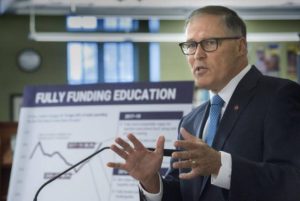 Today, Governor Inslee released his

 By Suzann Girtz, Ph.D., Associate Professor – Teacher Education, Gonzaga University
 This morning the Washington State Supreme Court issued their latest order on the
  Office of the Superintendent of Public Instruction (OSPI) is proposing new student discipline rules as a result of changes to the law made by HB 1541 in 2016. HB 1541 requires that expulsions be no longer than an academic term (previously a year); students cannot be long-term suspended or expelled for “discretionary discipline;” school districts must provide educational services to students while they are suspended or expelled; and other changes to the development and distribution of district discipline policies, training, and reengagement plans.
 By Daniel Zavala, Director of Policy and Government Relations